
News
Journal of Contemporary Chiropractic | J Contemp Chiropr 2020; Volume 3: 21-27
13 Years of Chronic Headaches — Gone: How One Woman’s Whiplash Was Finally Healed by Fixing Her Spine
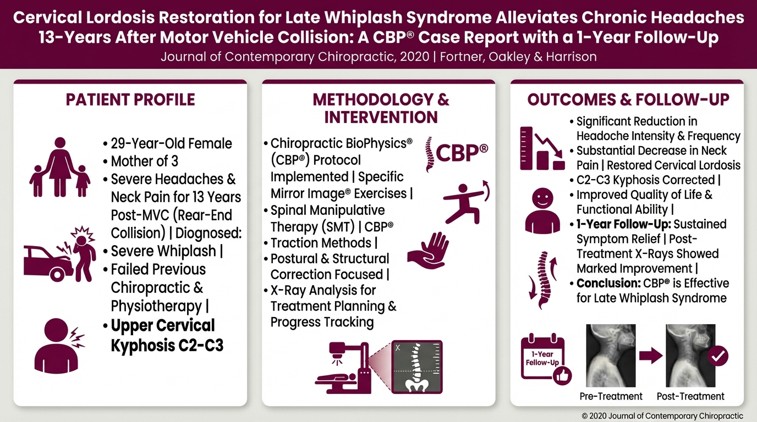
After 13 years of suffering from a car accident, CBP® achieves extraordinary 25° cervical lordosis correction with sustained 1 -year results.
For most of us, a car accident is a terrifying event that we hope to leave in the past. But for one 29-year-old woman, the collision she survived at age 16 didn’t end when the cars stopped moving. Instead, it began a 13-year sentence of daily pain, marked by chronic, debilitating headaches, persistent neck stiffness, and a cascade of bodily symptoms that simply would not resolve.
Over more than a decade, she sought relief through conventional methods, yet the symptoms persisted. The headaches became a constant companion, eroding her quality of life and turning ordinary days into tests of endurance. Her case is a stark example of “Late Whiplash Syndrome,” where the trauma of an old injury continues to haunt the patient long after the visible wounds have healed.
However, after 13 years of searching, hope finally arrived in the form of Chiropractic BioPhysics® (CBP). A recent case study published in the Journal of Contemporary Chiropractic documents her remarkable journey from chronic disability to a pain-free life, proving that even after a decade of suffering, structural correction of the spine can yield miraculous results.
What is Late Whiplash Syndrome?
Late Whiplash Syndrome (LWS) describes a condition where symptoms from a whiplash injury persist for months or, in this extreme case, years after the initial trauma. While soft tissues like muscles and ligaments eventually heal, the force of a collision can fundamentally alter the alignment of the spine. If this alignment is not corrected, the spine functions poorly, much like a car with a bent frame.
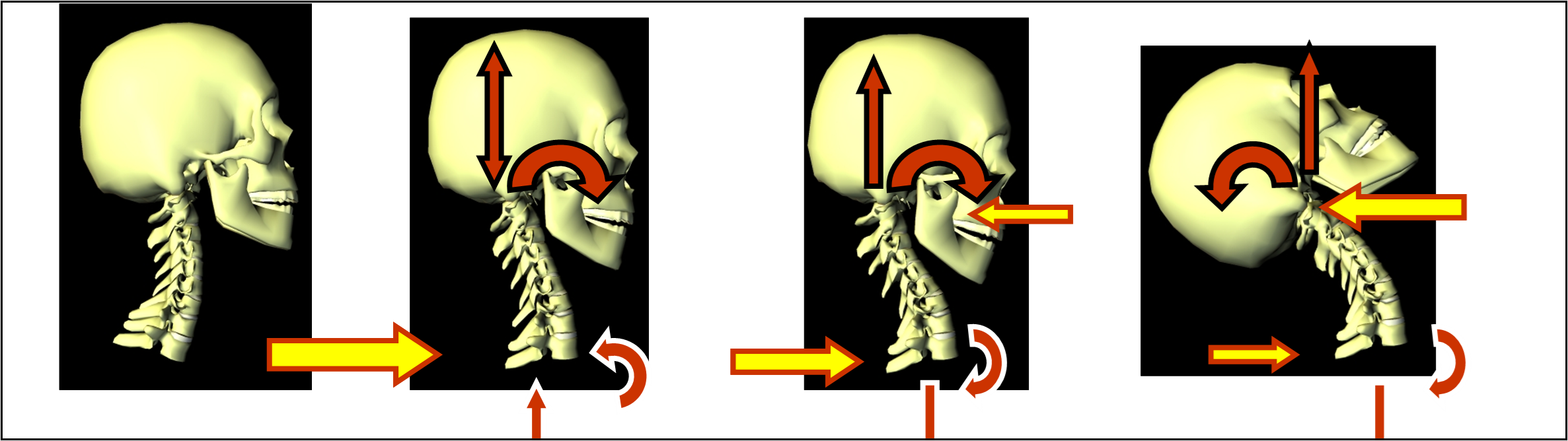
Figure 1. Rear end collisions cause alteration in the alignment of the cervical curve during impact. The normal curve is shown on the left. The 2nd and 3rd image show the injury phase of the collision and alteration of the cervical curve into an S-curve (a type of curve reversal). While the image on the right shows the extension phase of the collision.
For patients with LWS, the pain isn’t just “in their head”—it is often rooted in a hidden structural problem known as cervical kyphosis. This condition acts as a constant, low-grade mechanical stressor that prevents the nervous system from calming down, leading to chronic headaches, neck pain, and disability that medication can mask but rarely cures.
The Hidden Structural Problem: Cervical Kyphosis
A healthy human neck has a natural C-shaped curve known as a lordosis, which curves forward towards the throat. This shape acts as a shock absorber and keeps the spinal cord relaxed. However, the violent whipping motion of a car accident can snap this curve backward. When the neck loses its healthy curve and bends the opposite way, it is called a cervical kyphosis.
In this patient’s case, X-rays revealed a significant reversal of her neck curve. This abnormal structure places immense tension on the spinal cord and nerve roots. It stretches the muscles at the back of the neck constantly, forcing them to work overtime just to hold the head up. Over 13 years, this uncorrected structural deformity was likely the primary driver of her chronic headaches and widespread symptoms.
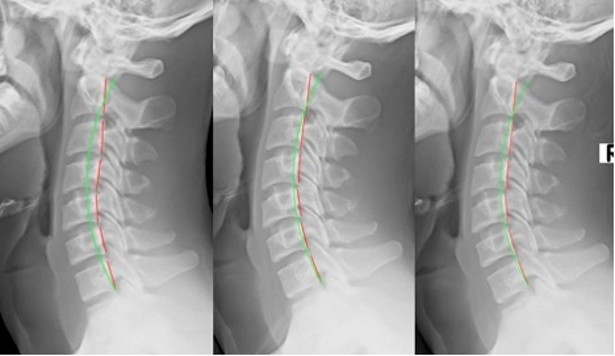
Figure 2. Lateral cervical radiographs. Left: Initial (1/3/18) image showing forward head translation and hypolordosis; Middle: Post-treatment (3/7/18) showing reduction in forward head translation and increase in cervical curve; Right: Follow-up (7/16/18) showing maintenance of structural improvements.
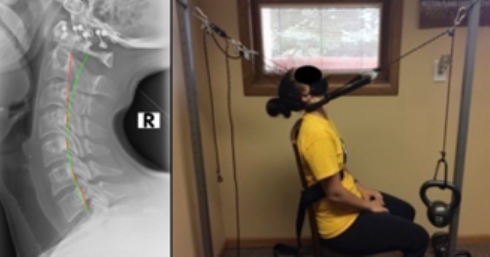
Figure 2. Left: Lateral cervical stress view. Patient is laying supine with a Denneroll under the mid-cervical spine. Right: Pope 2-way cervical extension traction.
What is Chiropractic BioPhysics® (CBP)?
Chiropractic BioPhysics® is the most researched chiropractic technique in the world focused on structural spinal rehabilitation. Unlike traditional methods that prioritize temporary pain relief, CBP aims to permanently correct the shape of the spine. It utilizes a multimodal approach including Mirror Image® exercises, specialized extension traction, and precise spinal adjustments to restore normal posture and alignment.
25° IMPROVEMENT
IN CERVICAL LORDOSIS25° IMPROVEMENT
IN CERVICAL LORDOSIS
13 Years of Headaches Resolved
Results Sustained at 1-Year Follow-Up
| Measurement | Before Treatment | AFTER 64 Sessions | 1-Year Follow-Up |
|---|---|---|---|
| Cervical Lordosis | Severely Reduced (kyphotic) | +25° improvement | Maintained ✅ |
| Forward Head Posture | Severe anterior translation | Significantly reduced | Maintained ✅ |
| Chronic Headaches | Daily, debilitating (13 years) | Dramatically resolved | Resolved ✅ |
| Neck Pain | Persistent, chronic | Dramatically improved | Improved ✅ |
| Widespread Body Symptoms | Multiple LWS symptoms | Resolved | Resolved ✅ |
| Quality of Life | Severely impacted | Markedly improved | Sustained ✅ |
The 13-Year Breakthrough
This case represents one of the most dramatic structural corrections documented in CBP literature—a staggering 25° improvement in cervical lordosis. But the numbers only tell half the story. The true breakthrough lies in the timeline: this patient had suffered for 13 years before finding a solution.
This study shatters the myth that “old” injuries cannot be healed. It demonstrates that even late-stage, chronic whiplash syndrome with severe structural abnormalities can be reversed through dedicated structural rehabilitation. Perhaps most encouragingly, the 1-year follow-up examination proved that the correction was stable. The patient required only minimal maintenance care to keep her headaches away, proving that CBP offers a sustainable, long-term solution rather than a temporary fix.
What This Means for Chronic Headache Sufferers
If you have been suffering from chronic headaches following a car accident—whether it was last year or a decade ago—this case offers profound hope. Many patients are told that they must simply “live with” their pain or manage it with medication. This case study suggests otherwise.
The persistence of your symptoms may be due to an overlooked structural cause: cervical kyphosis. Conventional treatments often fail because they address the muscles or the pain signals, but ignore the underlying geometry of the spine. CBP offers a pathway to correction even years after the initial injury. It emphasizes a powerful truth: it is never too late to restore proper spinal alignment and reclaim a life free from chronic pain.
About Chiropractic BioPhysics® (CBP®)
Chiropractic BioPhysics® is the most evidence-based, published named chiropractic technique system in the world, with over 350 peer-reviewed publications. CBP® uses precise mathematical spinal models and Mirror Image® adjusting, exercise, and spine remodeling or traction protocols — including the Denneroll orthotic used in this study — to achieve lasting structural correction of spinal alignment. Learn more at idealspine.com and cbpnonprofit.com.
About CBP Non-Profit
This publication reflects the mission of CBP Non-Profit—advancing spine and posture research to improve patient care worldwide. Our ongoing projects continue to validate the role of posture correction in musculoskeletal and neurological health.
 Learn more: www.CBPNonprofit.com
About CBP Non-Profit
CBP NonProfit is a 501(c)(3) research foundation dedicated to the advancement of spine rehabilitation through high-quality, peer-reviewed chiropractic and physiotherapy research. With over 350 published studies to date, CBP NonProfit is a global leader in evidence-based spinal care innovation.
CBP NonProfit
Video Library

CBP NonProfit
300+ Peer-Reviewed Publications
Chiropractic Biophysics Non-profit, Inc. is a 501(c)(3) nonprofit corporation dedicated to the advancement of chiropractic principles through scientific research. Dr. Don Harrison (deceased) and his second wife Dr. Deanne LJ Harrison (deceased) founded CBP research foundation in 1982; it was registered as CBP Non-Profit, Inc. in 1989 by Dr. Sang Harrison (Don’s 3rd and final life’s love). Through this organization Dr. Don and colleagues have published over 300 peer-reviewed spine and Chiropractic research publications. Further, CBP Non-Profit, Inc. has funded many scholarships as well as donated chiropractic equipment to many chiropractic colleges; always trying to support chiropractic advancement and education. Dr. Don Harrison was the acting president of CBP Non-Profit, Inc. since 1982. Currently, Dr. Deed Harrison (Don’s son) is the President of CBP Non-Profit, Inc. Read More