
News
New Study in Scientific Reports: Forward Head Posture Identified as Major Barrier to Recovery for Chronic Neck Pain Patients
Eagle, Idaho — April 7, 2026
A groundbreaking multicenter study published in the prestigious Nature-affiliated journal Scientific Reports has revealed that structural alignment of the cervical spine is a critical predictor of rehabilitation success. The research, titled “The Magnitude of Sagittal Head Posture Displacement and Patient Demographics Predict Rehabilitation Outcomes in Patients with Chronic Nonspecific Neck Pain,” identifies forward head posture (FHP) as a significant biomechanical factor that reduces the effectiveness of standard physical therapy treatments by up to 13% for every inch of displacement.
The Silent Epidemic: Chronic Neck Pain
Chronic nonspecific neck pain (CNSNP) is a pervasive global health issue, ranking as the fourth leading cause of disability worldwide. While standard conservative treatments— including manual therapy, exercise, and modalities—are widely prescribed, success rates vary significantly, and recurrence is common. Until now, the specific biomechanical and demographic factors that predict who will succeed and who will fail have been poorly understood.
This prospective study, led by Ghydaa Anwar and Professor Ibrahim Moustafa in collaboration with Dr. Deed Harrison of CBP NonProfit, aimed to bridge this gap by analyzing how head posture and patient demographics influence long-term recovery outcomes.
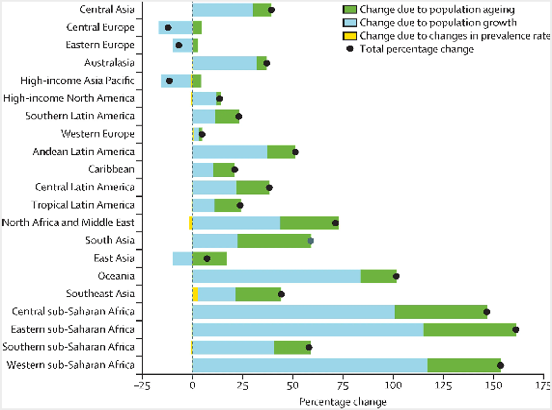
The global burden of neck pain continues to rise, necessitating more targeted treatment approaches.
Study Design & Methodology
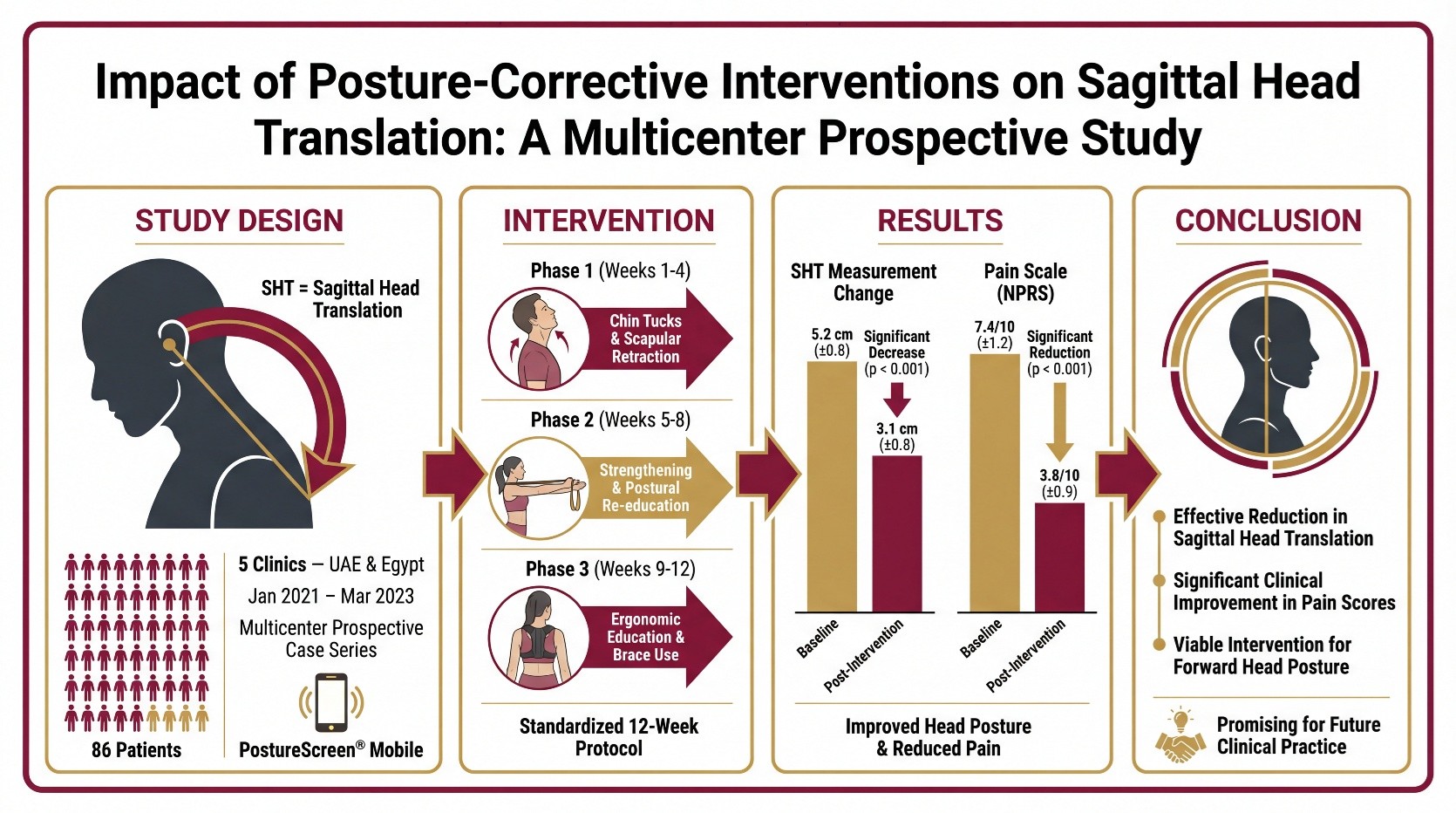
The research team conducted a prospective consecutive case series involving 86 patients with chronic nonspecific neck pain across five physiotherapy clinics in the UAE and Egypt. Participants underwent an 8-week multimodal rehabilitation program that included:
- Patient education and ergonomic advice
- Therapeutic exercises (stabilization and strengthening) Manual therapy (Grade III mobilizations)
- Physical modalities (TENS, heat)
Researchers used advanced digital postural analysis (PostureScreen® Mobile) to measure sagittal head translation (SHT) and tracked clinical outcomes using the Patient-Centered Outcome Questionnaire (PCOQ) at a 6-month follow-up.
86PATIENTS MONITORED |
8 WeeksTREATMENT DURATION |
5 ClinicsMULTICENTER STUDY |
|---|
Key Findings: Anatomy Predicting Destiny?
The study’s most significant finding was the powerful predictive relationship between structural alignment and treatment success. Even when patients received high-quality care, their baseline posture heavily influenced their outcome.
-13%
Reduction in odds of success for every 1-inch increase in forward head posture.-13%
Reduction in odds of success for every 1-inch increase in forward head posture.
2.7x
Higher odds of overall treatment success for female patients compared to males.2.7x
Higher odds of overall treatment success for female patients compared to males.
Age Factor
Younger patients showed significantly better outcomes; success odds decreased as age increased.Age Factor
Younger patients showed significantly better outcomes; success odds decreased as age increased.
60%+
Overall success rate across pain, fatigue, distress, and interference domains.60%+
Overall success rate across pain, fatigue, distress, and interference domains.
Understanding Sagittal Head Translation (SHT)
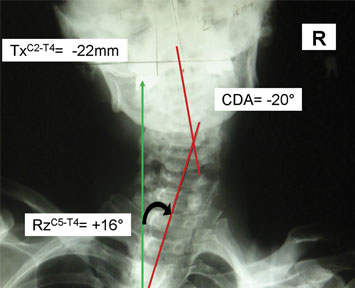
Sagittal Head Translation, commonly known as “Forward Head Posture,” occurs when the head shifts anteriorly relative to the shoulders. This displacement increases the gravitational moment arm, placing excessive strain on the posterior cervical muscles and spinal structures.
“This research fundamentally shifts our understanding of neck pain rehabilitation. It’s not just about treating the pain; it’s about understanding the biomechanical barriers to recovery. We now have concrete evidence that sagittal head translation is a primary driver of poor clinical outcomes.”
— Dr. Deed E. Harrison, Study Co-Author & President of CBP NonProfit
Clinical Implications for Practitioners
For clinicians, physical therapists, and chiropractors, these findings necessitate a shift in assessment protocols:
- Screening is Vital: Routine screening for sagittal head translation should be standard practice for all neck pain patients.
- Prognostic Value: Identifying significant FHP early can help manage patient expectations regarding recovery timelines.
- Targeted Intervention: Since FHP is a barrier to recovery, therapies specifically designed to correct structural alignment (such as CBP® methods) may be necessary for patients with significant displacement.
Future Research Directions
The authors suggest that future studies should focus on randomized controlled trials comparing standard care against multimodal programs that explicitly include structural correction of forward head posture. Such research could further validate the necessity of biomechanical correction in chronic pain management.
Media Contact:
CBP NonProfit Inc.
950 E. Riverside Drive, Eagle, ID 83616 Phone: 208-939-0301
Email: [email protected]
Website: www.idealspine.com
Source: Anwar, G., Moustafa, I.M., Ahbouch, A. et al. The magnitude of sagittal head posture displacement and patient demographics predict rehabilitation outcomes in patients with chronic nonspecific neck pain. Sci Rep 15, 4187 (2025). https://doi.org/10.1038/s41598-025-04187-x
About Chiropractic BioPhysics® (CBP®)
Chiropractic BioPhysics® is the most evidence-based, published named chiropractic technique system in the world, with over 350 peer-reviewed publications. CBP® uses precise mathematical spinal models and Mirror Image® adjusting, exercise, and spine remodeling or traction protocols — including the Denneroll orthotic used in this study — to achieve lasting structural correction of spinal alignment. Learn more at idealspine.com and cbpnonprofit.com.
About the Authors
This study was conducted by researchers including Dr. Deed E. Harrison, President of CBP NonProfit Inc. CBP® (Chiropractic BioPhysics®) is one of the most researched chiropractic techniques in the world, focusing on optimal posture and spinal alignment as the primary goals of care. By combining physics, geometry, and biology, CBP® doctors aim to restore normal spinal mechanics to improve overall health.
About CBP Non-Profit
This publication reflects the mission of CBP Non-Profit—advancing spine and posture research to improve patient care worldwide. Our ongoing projects continue to validate the role of posture correction in musculoskeletal and neurological health.
 Learn more: www.CBPNonprofit.com
About CBP Non-Profit
CBP NonProfit is a 501(c)(3) research foundation dedicated to the advancement of spine rehabilitation through high-quality, peer-reviewed chiropractic and physiotherapy research. With over 350 published studies to date, CBP NonProfit is a global leader in evidence-based spinal care innovation.
CBP NonProfit
Video Library

CBP NonProfit
300+ Peer-Reviewed Publications
Chiropractic Biophysics Non-profit, Inc. is a 501(c)(3) nonprofit corporation dedicated to the advancement of chiropractic principles through scientific research. Dr. Don Harrison (deceased) and his second wife Dr. Deanne LJ Harrison (deceased) founded CBP research foundation in 1982; it was registered as CBP Non-Profit, Inc. in 1989 by Dr. Sang Harrison (Don’s 3rd and final life’s love). Through this organization Dr. Don and colleagues have published over 300 peer-reviewed spine and Chiropractic research publications. Further, CBP Non-Profit, Inc. has funded many scholarships as well as donated chiropractic equipment to many chiropractic colleges; always trying to support chiropractic advancement and education. Dr. Don Harrison was the acting president of CBP Non-Profit, Inc. since 1982. Currently, Dr. Deed Harrison (Don’s son) is the President of CBP Non-Profit, Inc. Read More