
News
The Journal of Physical Therapy Science | J. Phys. Ther. Sci. 36: 44–50, 2024
After Surgery Failed Him, Chiropractic BioPhysics® Gave Him His Life Back — 6 Years of Proof
27-Year-Old’s Journey from Failed Spinal Surgery to Full Recovery Through Non-Surgical CBP® Structural Rehabilitation
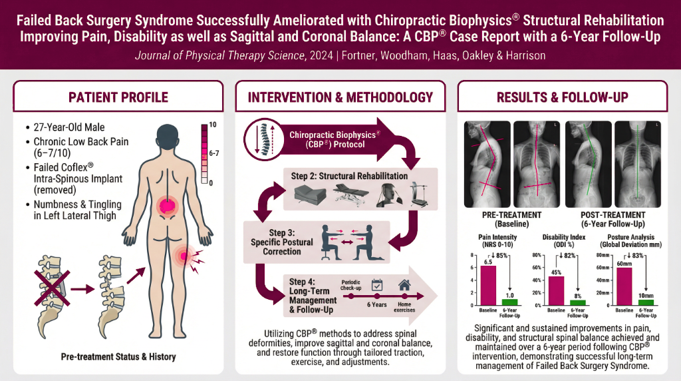
At just 27 years old, most people are in the prime of their lives. But for one young man, life had become a cage of chronic pain.
Suffering from debilitating low back pain and leg numbness, he did what many patients do: he trusted the conventional medical route. In 2012, he underwent spinal surgery to implant a Coflex® interspinous device between his L3 and L5 vertebrae, hoping for relief. Instead, the outcome was a nightmare scenario known all too well in the medical community: Failed Back Surgery Syndrome (FBSS).
His condition worsened immediately. The pain intensified, his disability increased, and within a year, the device had to be surgically removed. He was left with severe structural deformities, a “hypolordotic” (flat) lower back, and a quality of life that was spiraling downward.
But his story didn’t end there. A groundbreaking case study published in the Journal of Physical Therapy Science (2024) details how this patient found salvation not in another operating room, but through the rigorous, evidence-based protocols of Chiropractic BioPhysics® (CBP).
When Surgery Becomes the Problem: Understanding Failed Back Surgery Syndrome
Failed Back Surgery Syndrome is a distressing condition where patients continue to experience pain—or suffer from new, worse pain—after spinal surgery. It is a complex clinical challenge that leaves many patients feeling hopeless, believing they have exhausted all options.
In this case, the patient’s initial surgery failed to address the root cause of his suffering: structural spinal misalignment. Without correcting the underlying posture and curvature of the spine, the surgical intervention was like building a house on a crumbling foundation.
The Balance Problem: Sagittal and Coronal Spinal Alignment
To understand why this patient was in pain, we must look at the biomechanics of the spine. A healthy spine relies on precise alignment in two planes:
- Sagittal Balance (Side View): The spine should have healthy curves—a lordosis (inward curve) in the neck and lower back, and a kyphosis (outward curve) in the upper This patient had a “flat back” (hypolordosis) of only -16.1°, far below the normal range, causing immense strain on his discs and nerves.
- Coronal Balance (Front View): The spine should be straight up and This patient suffered from significant shifts, with his ribcage translated nearly 30mm to the left and shifted backward by nearly 90mm.
These severe misalignments created abnormal loading patterns that no amount of medication or localized surgery could fix. He needed a structural overhaul.
What is Chiropractic BioPhysics® (CBP)?
Chiropractic BioPhysics® is widely recognized as one of the most scientific and researched chiropractic techniques in the world. Unlike traditional chiropractic, which focuses primarily on immediate symptom relief, CBP aims for structural rehabilitation.
By combining physics, engineering, and physiology, CBP practitioners use mirror-image adjustments, specialized traction, and corrective exercises to permanently reshape the spine, restoring normal curvature and alignment.
75% DISABILITY REDUCTION
6 YEARS OF SUSTAINED IMPROVEMENT75% DISABILITY REDUCTION
6 YEARS OF SUSTAINED IMPROVEMENT
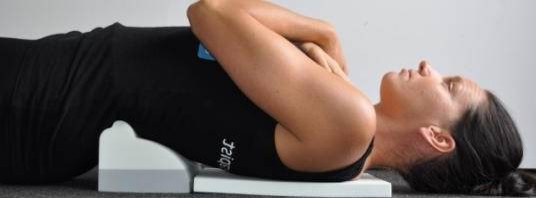
Spine Corrective Mirror Image® traction therapy — key components of CBP® treatment
The Results: A Life Reclaimed
The results of the 5.5-month treatment plan were nothing short of life-changing. But the true test of any medical intervention is time. This case study is unique because it followed the patient for six years post-treatment, proving that the results were not just temporary—they were lasting.
| Metric | BEFORE Treatment | AFTER 5.5 Months | 6-Year Follow-Up |
|---|---|---|---|
| Back Pain Level | 6–7 / 1 0 | Significant Decrease | 70% Improvement Maintained |
| Oswestry Disability Index (ODI) | 24% (Moderate Disability) | 6% (Minimal Disability) | Sustained Low Disability |
| Lumbar Lordosis (Curve) | -16.1 ° (Flat) | -22.3° (Improved) | Correction Maintained |
| Posterior Thoracic Translation | -88.7 mm (Severe) | Reduced by 21 mm | Further Reduced (-53.7 mm) |
| Lateral Thoracic Translation | 29.5 mm (Shifted) | Reduced by 16.1 mm | Correction Maintained |
| Leg Numbness | Present | Resolved | 100% Resolved |
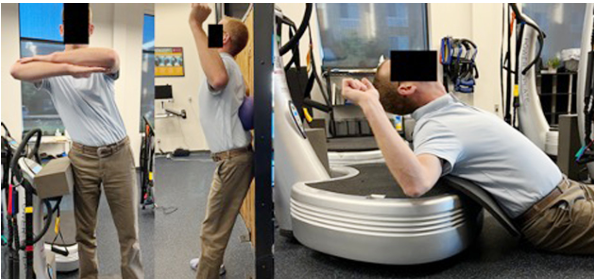
Mirror Image® exercises and spinal rehabilitation techniques. Left: Right thoracic translations. Middle: Back extensions with a block placed at the upper lower back. Right: Back extensions over the edge of a PowerPlate. All exercises were held for 5-seconds per repetition. All exercises were performed in-office; the middle exercise was performed at home.
The Non-Surgical Path Forward: Clinical Significance
This case adds to a growing body of evidence suggesting that non-surgical structural rehabilitation should be the first line of defense for complex spinal conditions, and a vital recovery tool even after surgery has failed.
The authors of the study concluded that correcting sagittal and coronal imbalances reduces abnormal loading on pain-sensitive tissues. Simply put: when the spine is straight, the pain stops. By addressing the root biomechanical cause rather than just the symptoms, CBP offered this patient a durability of relief that surgery could not.
Furthermore, the 6-year follow-up showed that while some degenerative changes naturally occurred at the site of the previous surgery, the patient’s overall function and quality of life remained high. This proves that a healthy spinal structure is the best insurance against future pain.
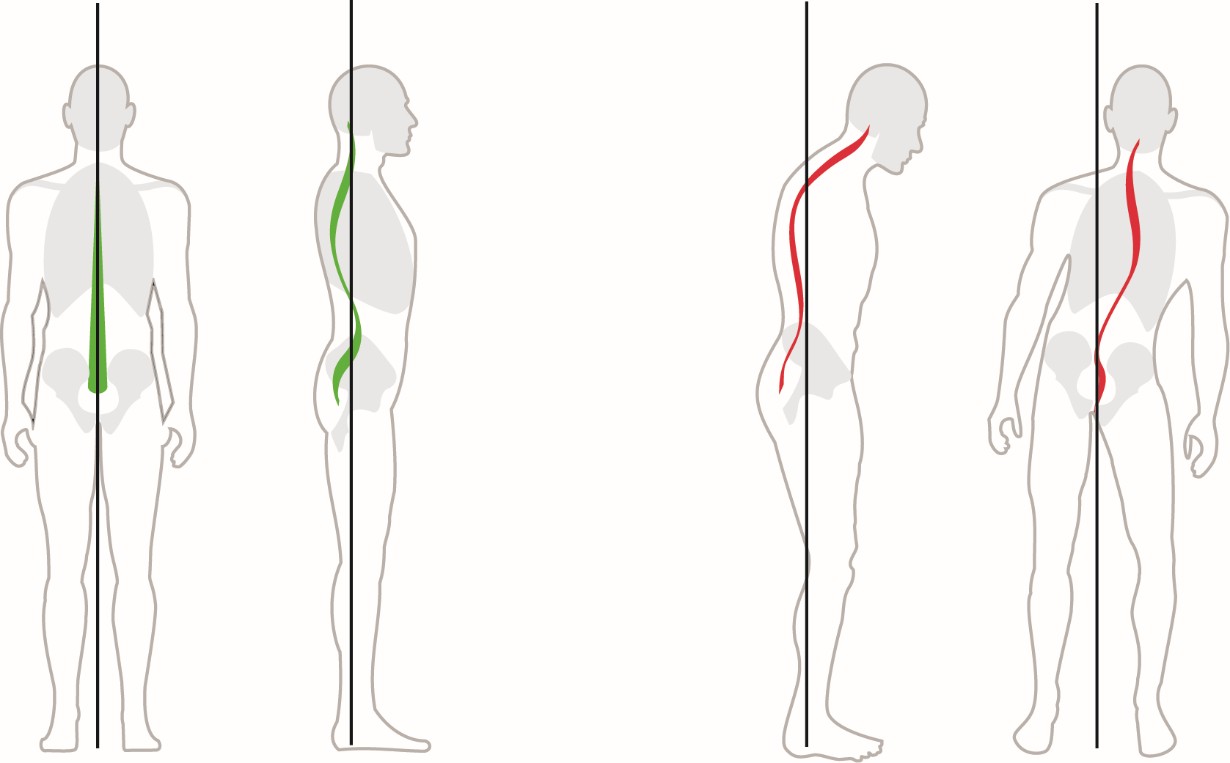
Postural correction through targeted CBP® exercises and traction procedures.
© 2024 Chiropractic BioPhysics® Education. All Rights Reserved. | Designed for Patient Education
Disclaimer: The content in this article is for educational purposes only and is not intended as medical advice.
About Chiropractic BioPhysics® (CBP®)
Chiropractic BioPhysics® is the most evidence-based, published named chiropractic technique system in the world, with over 350 peer-reviewed publications. CBP® uses precise mathematical spinal models and Mirror Image® adjusting, exercise, and spine remodeling or traction protocols — including the Denneroll orthotic used in this study — to achieve lasting structural correction of spinal alignment. Learn more at idealspine.com and cbpnonprofit.com.
About CBP Non-Profit
This publication reflects the mission of CBP Non-Profit—advancing spine and posture research to improve patient care worldwide. Our ongoing projects continue to validate the role of posture correction in musculoskeletal and neurological health.
 Learn more: www.CBPNonprofit.com
About CBP Non-Profit
CBP NonProfit is a 501(c)(3) research foundation dedicated to the advancement of spine rehabilitation through high-quality, peer-reviewed chiropractic and physiotherapy research. With over 350 published studies to date, CBP NonProfit is a global leader in evidence-based spinal care innovation.
CBP NonProfit
Video Library


CBP NonProfit
300+ Peer-Reviewed Publications
Chiropractic Biophysics Non-profit, Inc. is a 501(c)(3) nonprofit corporation dedicated to the advancement of chiropractic principles through scientific research. Dr. Don Harrison (deceased) and his second wife Dr. Deanne LJ Harrison (deceased) founded CBP research foundation in 1982; it was registered as CBP Non-Profit, Inc. in 1989 by Dr. Sang Harrison (Don’s 3rd and final life’s love). Through this organization Dr. Don and colleagues have published over 300 peer-reviewed spine and Chiropractic research publications. Further, CBP Non-Profit, Inc. has funded many scholarships as well as donated chiropractic equipment to many chiropractic colleges; always trying to support chiropractic advancement and education. Dr. Don Harrison was the acting president of CBP Non-Profit, Inc. since 1982. Currently, Dr. Deed Harrison (Don’s son) is the President of CBP Non-Profit, Inc. Read More