
News
CLINICAL CASE STUDY · PRESS RELEASE
Breakthrough CBP® Protocol Resolves 12-Year Chronic Whiplash Nightmare Where Traditional Care Failed
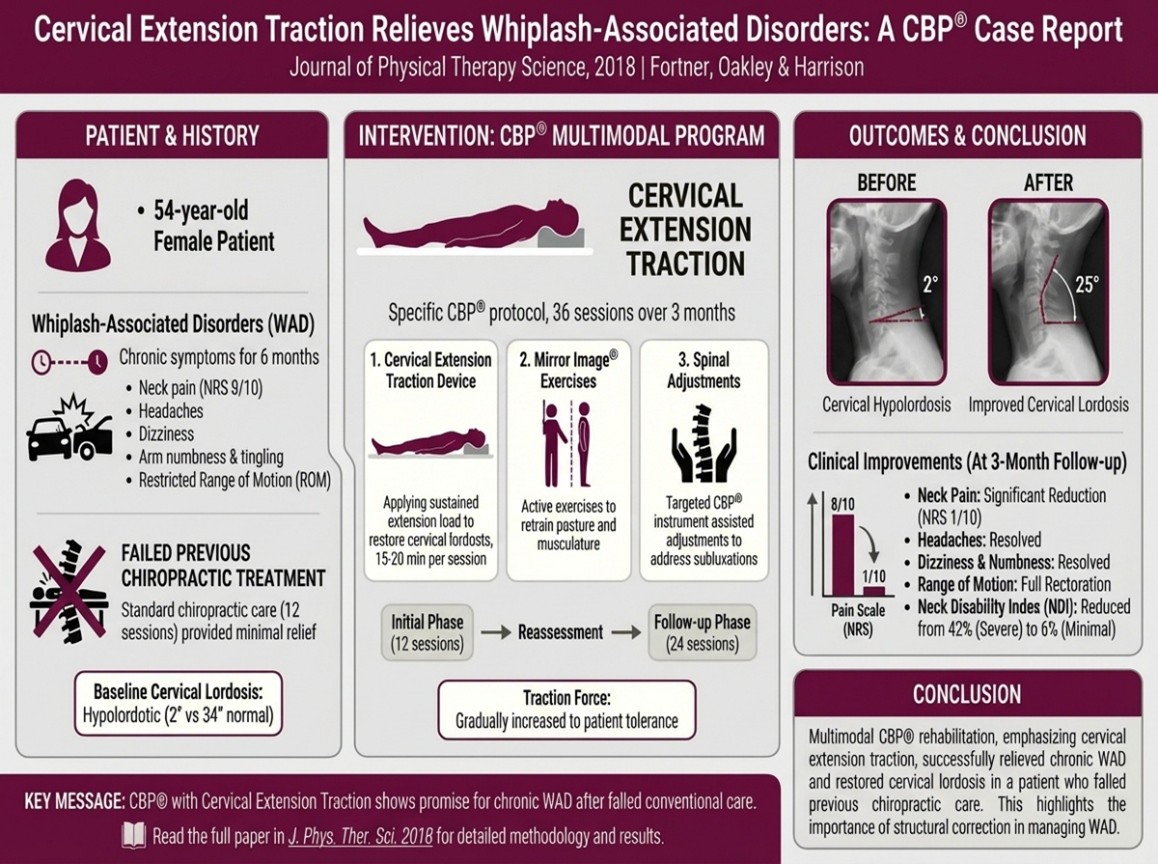
EAGLE, ID — A compelling new case study published in the Journal of Physical Therapy Science (201 8) offers renewed hope for millions suffering from chronic Whiplash Associated Disorders (WAD). The study details the remarkable recovery of a 31 -year-old female patient who, after suffering for over a decade with debilitating neck pain and headaches, achieved near-complete symptom resolution through Chiropractic BioPhysics® (CBP®) structural rehabilitation
12
YEARS OF CHRONIC PAIN12
YEARS OF CHRONIC PAIN
100%
SYMPTOM IMPROVEMENT100%
SYMPTOM IMPROVEMENT
13.3°
LORDOSIS CORRECTION13.3°
LORDOSIS CORRECTION
The “Invisible” Injury: A Decade of Suffering
Whiplash injuries are notoriously difficult to treat, often leaving patients with “invisible” chronic pain that persists long after the initial soft tissue damage has theoretically healed. In this documented case, a 31-year-old female presented with a history of constant neck pain and daily headaches stemming from a whiplash injury sustained 12 years prior. Her pain levels averaged 3/10 daily but spiked to a debilitating 7/10 during work activities involving protective headgear.
Perhaps most frustrating for the patient was the failure of previous treatments. Despite undergoing traditional chiropractic spinal manipulative therapy (SMT), her symptoms persisted. This is a common narrative in chronic WAD cases, where functional improvements are often temporary because the underlying structural deformation—specifically the loss of the cervical lordotic curve—remains unaddressed.
The CBP® Difference: Structural Correction vs. Symptom Management
The turning point for this patient was the application of Chiropractic BioPhysics® (CBP®), a highly advanced, scientific technique that focuses on correcting the spine’s alignment to its ideal geometric shape. Unlike general manipulation which mobilizes joints, CBP® aims to permanently remodel the spinal structure.
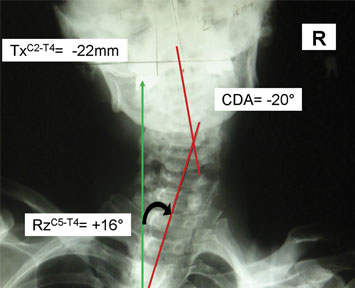
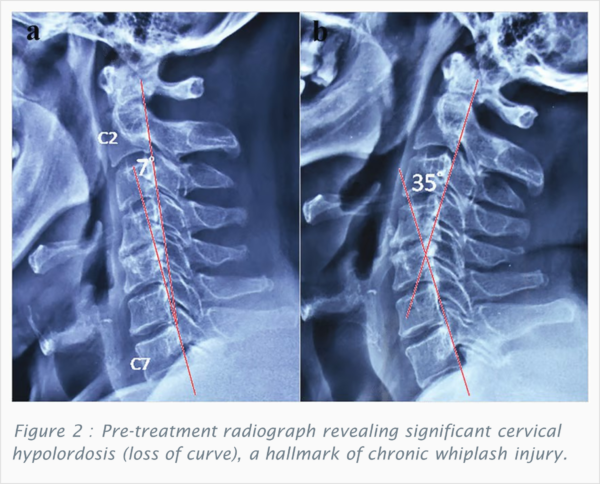
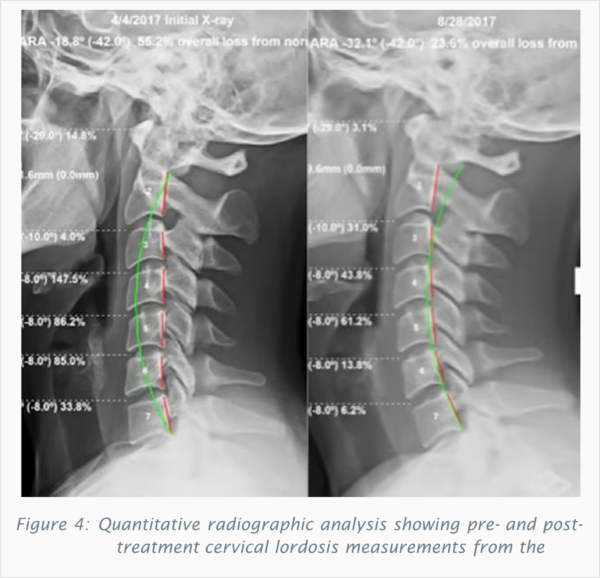
Upon initial radiographic assessment, the patient was diagnosed with cervical hypolordosis. The natural C-shaped curve of her neck measured an Absolute Rotation Angle (ARA) of -18.8°, significantly less than the established normal range of -31 ° to -42°. This straightening of the neck places immense tension on the spinal cord and nerve roots, a condition known as “adverse mechanical cord tension,” which is frequently the root cause of chronic WAD symptoms.
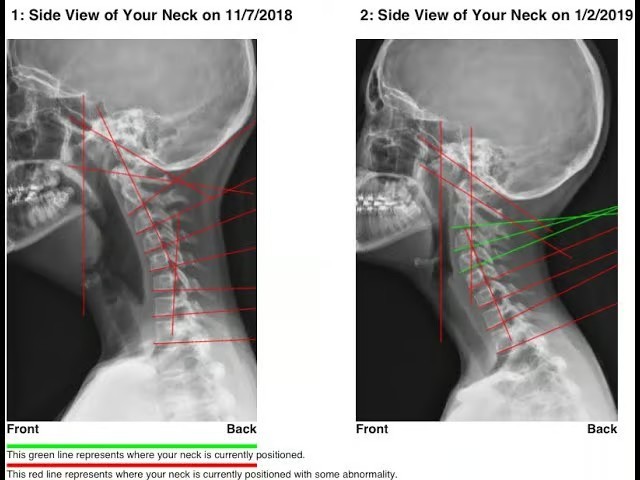
Figure 3: Example of cervical extension traction mechanics used to restore the natural lordotic curve.
Clinical Outcomes: A Return to Normal Life
The results of this multimodal approach were nothing short of transformative. Post-treatment assessment revealed a dramatic structural change and complete symptom resolution.
Structural Improvements
Radiographic analysis showed a significant restoration of the cervical curve. The C2-C7 ARA improved from a pathological -18.8° to a healthy -32.1 °. This 13.3° improvement moved the patient’s spinal alignment directly into the normal range, alleviating the mechanical tension on her nervous system.
Symptomatic Relief
More importantly for the patient’s quality of life, the structural correction correlated directly with pain relief:
- Neck Pain: Reduced to 0/10
- Headaches: Completely resolved (0/10).
- Function: The patient reported she could now wear her required hardhat at work without triggering
- Overall Health: The patient self-reported a 90-100% improvement in all previous health complaints.
“This case adds to the accumulating evidence that restoring lordosis may be key in treating chronic whiplash syndrome.”
Conclusion: The Necessity of Curve Restoration
This case study, authored by Miles O. Fortner, DC, Paul A. Oakley, DC, MSc, and Deed E. Harrison, DC, underscores a critical limitation in standard physical therapy and general chiropractic manipulation for chronic whiplash: the failure to correct spinal structure.
While mobilization and exercise can improve range of motion, they often fail to restore the cervical lordosis. Without correcting the curve, the spinal cord remains under tension, and symptoms inevitably return. The authors conclude that extension traction is likely the primary contributor to lordosis correction due to its ability to induce plastic deformation in spinal ligaments.
For patients stuck in the cycle of chronic pain management, CBP® offers a corrective solution that addresses the root cause rather than just the symptoms.

About Chiropractic BioPhysics® (CBP®)
Chiropractic BioPhysics® is the most evidence-based, published named chiropractic technique system in the world, with over 350 peer-reviewed publications. CBP® uses precise mathematical spinal models and Mirror Image® adjusting, exercise, and spine remodeling or traction protocols — including the Denneroll orthotic used in this study — to achieve lasting structural correction of spinal alignment. Learn more at idealspine.com and cbpnonprofit.com.
About CBP Non-Profit
This publication reflects the mission of CBP Non-Profit—advancing spine and posture research to improve patient care worldwide. Our ongoing projects continue to validate the role of posture correction in musculoskeletal and neurological health.
 Learn more: www.CBPNonprofit.com
About CBP Non-Profit
CBP NonProfit is a 501(c)(3) research foundation dedicated to the advancement of spine rehabilitation through high-quality, peer-reviewed chiropractic and physiotherapy research. With over 350 published studies to date, CBP NonProfit is a global leader in evidence-based spinal care innovation.
CBP NonProfit
Video Library

CBP NonProfit
300+ Peer-Reviewed Publications
Chiropractic Biophysics Non-profit, Inc. is a 501(c)(3) nonprofit corporation dedicated to the advancement of chiropractic principles through scientific research. Dr. Don Harrison (deceased) and his second wife Dr. Deanne LJ Harrison (deceased) founded CBP research foundation in 1982; it was registered as CBP Non-Profit, Inc. in 1989 by Dr. Sang Harrison (Don’s 3rd and final life’s love). Through this organization Dr. Don and colleagues have published over 300 peer-reviewed spine and Chiropractic research publications. Further, CBP Non-Profit, Inc. has funded many scholarships as well as donated chiropractic equipment to many chiropractic colleges; always trying to support chiropractic advancement and education. Dr. Don Harrison was the acting president of CBP Non-Profit, Inc. since 1982. Currently, Dr. Deed Harrison (Don’s son) is the President of CBP Non-Profit, Inc. Read More