
News
Groundbreaking Study Confirms CBP® Can Reverse Cervical Kyphosis — and the Results Last
Eagle, Idaho — March 9, 2026 — CBP Seminars Research Team
Five-patient case series published in The Journal of Physical Therapy Science demonstrates significant structural correction and pain relief with long-term stability through CBP® extension traction protocols.
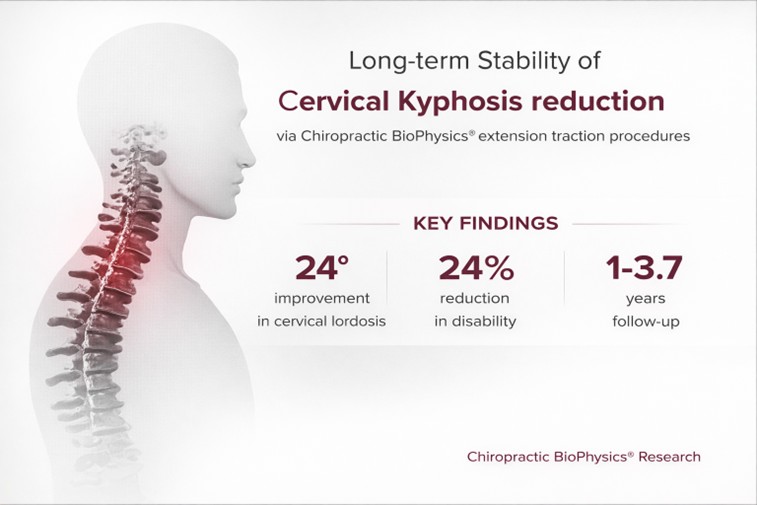
A new peer-reviewed case series has provided robust evidence that true cervical kyphosis—a pathological reversal of the neck curve— can be non-surgically corrected using Chiropractic BioPhysics® (CBP®) methods. Importantly, the study offers rare long-term data, tracking patients for years to understand the stability of spinal correction.
The Silent Epidemic — What Is Cervical Kyphosis?
The human neck is designed to have a lordosis—a natural “C” shaped curve that faces backwards. This curve acts as a shock absorber, distributes the weight of the head evenly, and protects the spinal cord and nerve roots. However, due to modern lifestyle factors like poor posture, trauma, or “text neck,” many individuals develop cervical kyphosis.
Cervical kyphosis is not just a cosmetic issue; it is a structural deformity where the neck curve reverses entirely. This abnormal alignment places immense strain on the spinal cord, often leading to chronic neck pain, headaches, disability, and accelerated degeneration of the spinal discs. Traditional manual therapy often provides temporary symptom relief but rarely addresses the underlying structural collapse.
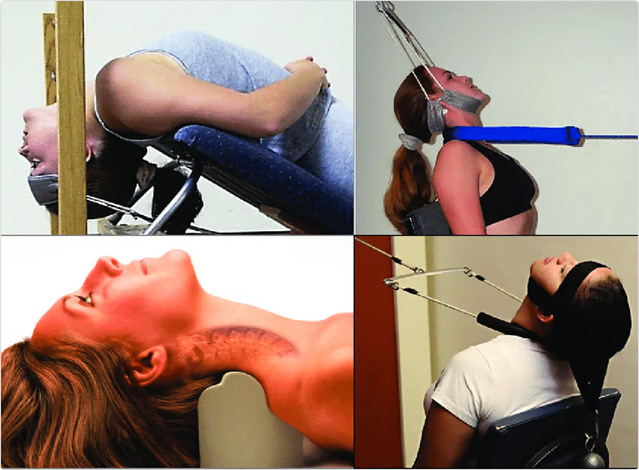
CBP® Cervical Extension Traction — courtesy CBP Seminars
The CBP® Protocol: A Three-Pronged Approach to Structural Correction
The study, authored by Tim C. Norton, Paul A. Oakley, Jason W. Haas, and Deed E. Harrison, treated five patients suffering from chronic neck pain and verified cervical kyphosis. Unlike standard physical therapy or manipulation alone, these patients underwent a rigorous multimodal CBP® protocol designed to remodel the spine.
The treatment approach included three essential components:
- Mirror Image® Extension Exercises: Patients performed specific movements to extend the head and neck, holding the position for 5 seconds over 50 repetitions to retrain postural
- Spinal Manipulative Therapy (SMT): Clinicians utilized high-velocity, low- amplitude adjustments and mirror-image drop table procedures to mobilize restricted
- Seated Extension Traction: This is the cornerstone of the correction. Patients used a weighted pulley system (illustrated above) to apply a consistent extension force to the neck for 10–15 minutes per session, inducing “creep” deformation in the ligaments to reshape the spinal
Remarkable Results: The Numbers Speak
The immediate results following the intensive treatment phase (averaging 41 sessions over 2–4 months) were statistically significant and clinically profound. Not only did the spinal structure improve, but patient quality of life skyrocketed.
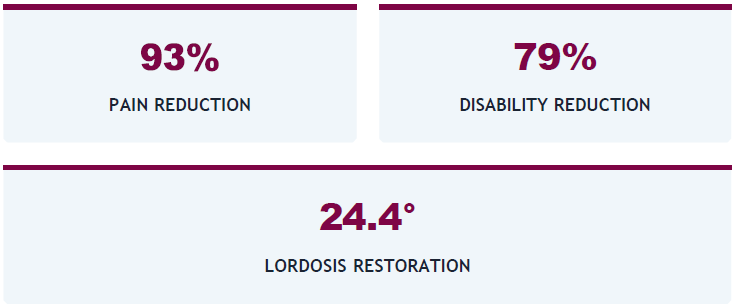
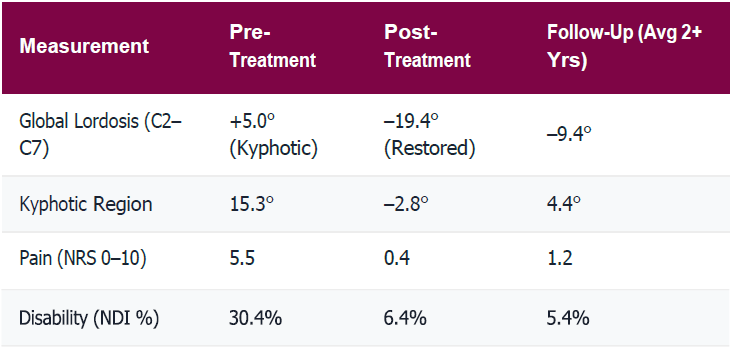
*Negative values indicate normal lordosis (extension); positive values indicate kyphosis (flexion).
The Long-Term Story — Why Maintenance Care Matters
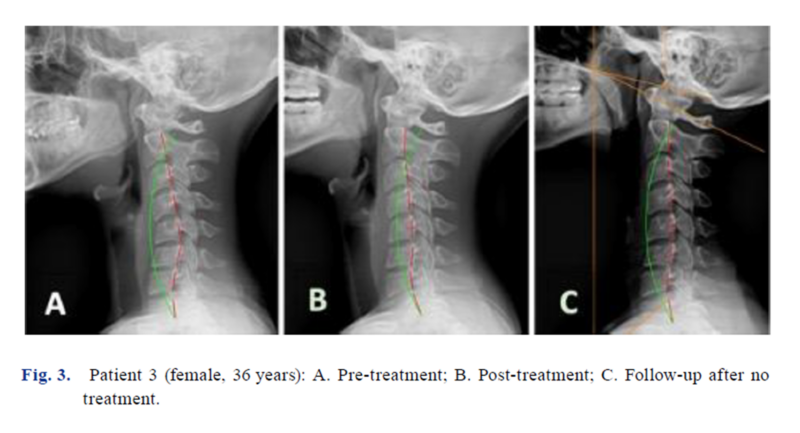
One of the most critical aspects of this study was the long-term follow-up, ranging from 11.5 months to 3.7 years. The researchers found that in patients who did not continue with maintenance care, the spine naturally began to regress toward its old shape.
On average, patients lost about 10° of their corrected curve over several years without ongoing treatment. However, interestingly, symptoms did not immediately return. Pain scores remained low (1.2/10) and disability scores remained excellent (5.4%). This suggests a “lag time” between structural regression and the return of pain.
The study concludes that to prevent this regression, a maintenance schedule of approximately two treatments per month is likely necessary to preserve the optimal spinal structure for life.
Why This Study Changes Everything
This is the first published case series demonstrating the non-surgical correction of true cervical kyphosis with such rigorous long-term follow-up. It challenges the conventional medical view that spinal deformities are permanent without surgery. It also highlights a critical blind spot in symptom-based care: feeling “fine” doesn’t mean the spine is stable.
“While the CBP® protocols successfully reduced cervical kyphosis and improved symptoms, radiographic screening is critical for follow-up because structural regression may occur even when patient-reported symptoms remain stable. Maintenance treatments at approximately twice per month are likely necessary to preserve structural gains.”
Reference: Tim C. Norton, Paul A. Oakley, Jason W. Haas, Deed E. Harrison, Long-term stability of reducing cervical kyphosis via Chiropractic Biophysics® extension traction procedures: a case series, Journal of Physical Therapy Science, 2026, Volume 38, Issue 1, Pages 32-38, Released on J-STAGE January 01, 2026, Online ISSN 2187-5626, Print ISSN 0915-5287, https://doi.org/10.1589/jpts.38.32, https://www.jstage.jst.go.jp/article/jpts/38/1/38_2025-109/_article/-char/en
Suffering from chronic neck pain or poor posture?
Contact a CBP® certified doctor today to determine if spinal misalignment is driving your symptoms.
CBP Seminars / IdealSpine
Eagle, Idaho
Phone: (208) 939-0301
About the Authors
This study was conducted by researchers including Dr. Deed E. Harrison, President of CBP NonProfit Inc. CBP® (Chiropractic BioPhysics®) is one of the most researched chiropractic techniques in the world, focusing on optimal posture and spinal alignment as the primary goals of care. By combining physics, geometry, and biology, CBP® doctors aim to restore normal spinal mechanics to improve overall health.
About CBP Non-Profit
This publication reflects the mission of CBP Non-Profit—advancing spine and posture research to improve patient care worldwide. Our ongoing projects continue to validate the role of posture correction in musculoskeletal and neurological health.
 Learn more: www.CBPNonprofit.com
About CBP Non-Profit
CBP NonProfit is a 501(c)(3) research foundation dedicated to the advancement of spine rehabilitation through high-quality, peer-reviewed chiropractic and physiotherapy research. With over 350 published studies to date, CBP NonProfit is a global leader in evidence-based spinal care innovation.
CBP NonProfit
Video Library

CBP NonProfit
300+ Peer-Reviewed Publications
Chiropractic Biophysics Non-profit, Inc. is a 501(c)(3) nonprofit corporation dedicated to the advancement of chiropractic principles through scientific research. Dr. Don Harrison (deceased) and his second wife Dr. Deanne LJ Harrison (deceased) founded CBP research foundation in 1982; it was registered as CBP Non-Profit, Inc. in 1989 by Dr. Sang Harrison (Don’s 3rd and final life’s love). Through this organization Dr. Don and colleagues have published over 300 peer-reviewed spine and Chiropractic research publications. Further, CBP Non-Profit, Inc. has funded many scholarships as well as donated chiropractic equipment to many chiropractic colleges; always trying to support chiropractic advancement and education. Dr. Don Harrison was the acting president of CBP Non-Profit, Inc. since 1982. Currently, Dr. Deed Harrison (Don’s son) is the President of CBP Non-Profit, Inc. Read More